
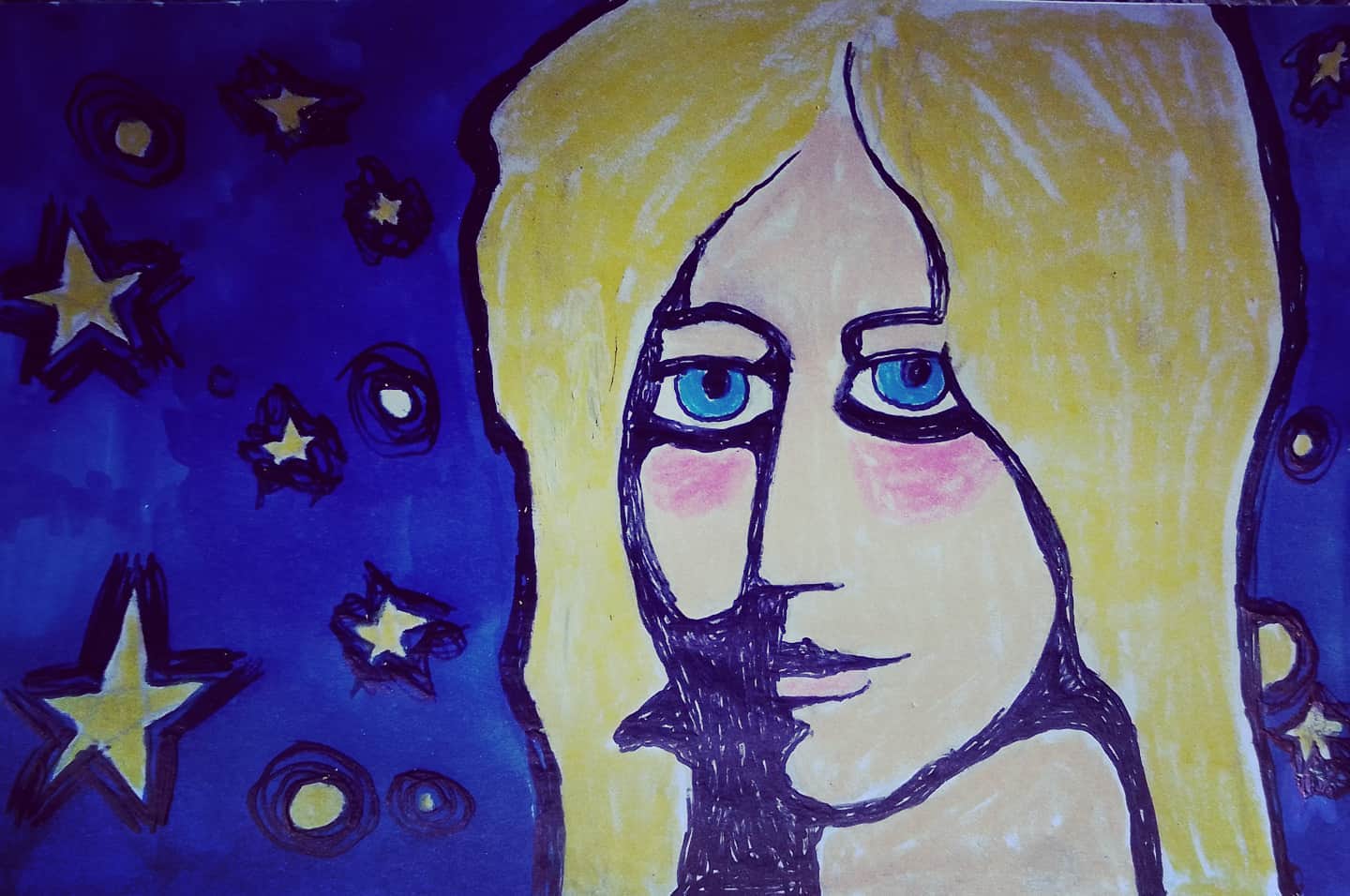
Das Bunte Leben (The Colorful Life) is a tempera on canvas painting by the Russian artist Wassily Kandinsky, from 1909. For me, its an inspiring work, and not what most would expect from the famous abstractionist. Below is my version of a detail of said painting. While not a copy, the most common words in the industry for doing such are either tribute or derivation, the first being a nod towards the originating artist, the second being theft to some degree or another, even if allowed by law. The difference may be whether you give credit where credit is due, or not.
You see a lot of derivative work in the common pop-art of today, where is some cases the derivative image, such as a batman, is well-enough known that the artist/copyist sees no need to cite credit, but I might ask them which batman did you take your copy from, was it a Kelley Batman, a Lee Batman, or a Bolland Batman? Most artists who might cover/inject one of these characters in a painting wouldn’t even know the difference, but if you laid one besides the other, you would see distinct differences. My favorite is the dark and turmoiled Kelly version. Some might even ask, “who cares?” We all know its a copy, right? To me, its simply a matter of credit where credit is due.

To explain, my image above was actually just a quick, colored sketch on a torn 4X5 inch piece of printer paper turned to scrap, done in marker and prismacolor pencils for no reason other than to explore what it was the original artist was doing. It was never meant to be more than just a sketch, an interpretation of what I saw and felt by this tiny part of a complex composition of figure-groups. I’ve always loved the rare illustrative work done by Wassily Kandinski during a very short period before he went over to the dark-side, getting into the geometric abstract work that he is so famous for today. But this isn’t about that, its about the other thing, the credit-where-credit-is-due thing. What’s the shame in crediting what inspires you? Does it diminish one as an artist to credit another? I suppose it might, if everything you do is derivative, projecting an image onto you canvas only to copy it, using tracing paper or a projector to do it the hard way, or even printing the image and cutting it out to paste on the canvas with 50 other characters in collage style. Even so, this thievery doesn’t prevent one from gaining recognition in many galleries that specialize in this form of unoriginal pop-art. At least in France, people who replicate old classic images proudly call themselves copyists, though our French popists wouldn’t bother with that any more than any other nationality.

The above painting is called Красочная жизнь in Kandinski’s native language, or the more common Das Bunte Leben (yeah, German), or even given the most understandable name (to the larger english-speaking world, even though Kandinski didn’t speak English), A Colorful Life. It is indeed colorful, and as a singular piece (vs. his severe, geometric abstract work), it does have its influence upon my work, as does work from many other artists from Goya to Bruegel (the elder) and many others. You can see the the original figure that mine derives from, or pays tribute to, in the lower right of the painting.
So yeah, maybe to explain the reason many artists might sample another’s work in personal terms. From time to time, I’ll use a recipe to cook something, tho’ usually not, but by doing so, by taking another persons recipe, I’m able to taste, to feel, what it is they’ve done. What they, as chefs, were exploring. Its an emersion into the world of another, discovering a part of a path that they discovered prior to your arrival. Then after that, I’m able to decide if I might use that same combination of spices, or whatever they might have used in their recipe, in my own recipe.
Okay, so painting isn’t quite the same as cooking, but it is if you look at things in a generalist sort of way, if you want to check out the vibes, let’s say, it is, I guess.


Leave a Reply