
Part One – The Potatoes.
I’d like to begin with three things.
The first is that this is the potato part of the meat and potatoes of the Modern Art industry, so really what I’m actually offering up is the Potatoes and Meat of Modern Art, only it doesn’t roll off the tongue so easily as the other, so there you go.
The second is that I intend on giving you, in an as-brief-as-possible time, an understanding of what modern art is, woven in with my own thoughts of the structure behind the industry of art. In this case, not only what modern art is, but what it is not, and how its become what it seems to be. The author apologizes, but figures adding that second bit will leave us certain that it really cannot be all that brief, hence, the three part thing. But, it will be fun!
The third, serving as a requisite, but applicable, non-sequitur, is that we’ve got to know that a painter doesn’t stand in front of a canvas saying “today, I’m going to create a some “modern art” any more than one would say they’re intent on painting a “contemporary art” painting. An artist doesn’t declare to the world that he’s begun works in his “blue” period. I intend here on helping to clear up that cryptic fog that our esteemed movers-and-shakers in the art industry wish was thicker than pea soup.
Modern Art’s back-office swindle
Most of what you know about art was meant to be confusing, by design, by exclusivity. Sadly, this psuedo-knowledge offered to us all puts space between the artist and the art-lover by means of installing a selling-machine between the two. Nothing unusual there; after all, it’s humans who are running this machine. Its a functional thing in theory: the artist gives up certain rights to represent his or her own work, since without having a talent for that, the artist leans towards some contentment with the situation, with finding a seller, and gains on time to pursue their primary activity of creating art. Sounds fair-enough, right? We all want a job.
That space between artist and art-lover can be filled with one or many positions, those positions being determined by function (experts and specialists). This is where we find the following: the agents, the gallerists, the curators and the dealers, etc. etc. etc. (there are others who also get their hands in the mix, and they will be mentioned later).
All these experts fill a position that needs to be needed, that position needs to be indispensable, as any agent, middleman, dealer, etc, in any industry needs to be needed. In the art world, this results in an overly-complex engrenage (English has no such term like this French word, and the the definition is as follows – A sequence of circumstances or actions that takes on a mechanical and irreversible character). It’s this world of artmongers that has decided that artists need a fabricated image, a brand, and that new approach works as a trickle-down thing — the less well-financed packages of the smaller galleries results in less sophisticated packaging. Small galleries are watched by larger, and larger now watched by then larger and larger, until we get to the largest, the big box galleries. From small to large, its a filtering system set in place to recruit from a small pond with overcrowded conditions on up to a very large pond with few elite inhabitants.
Its a food-chain, with each smaller business models and smaller artists hoping to become the suppliers for the higher-level, apex predators. Everything is a fabrication, a glamour, an illusion. Even the artist’s themselves are fabricated, but, admittedly, once you’re in the club, you are well-taken care of. Branded individuals are nothing new, but they are brands, and when branded, its not the artist that one knows, but the artists product as presented by the engrenage surrounding that artist. Its just another neat way to remove the artist from the equation. This is the foundation of the failure of the system.
The Auction House Rodeo

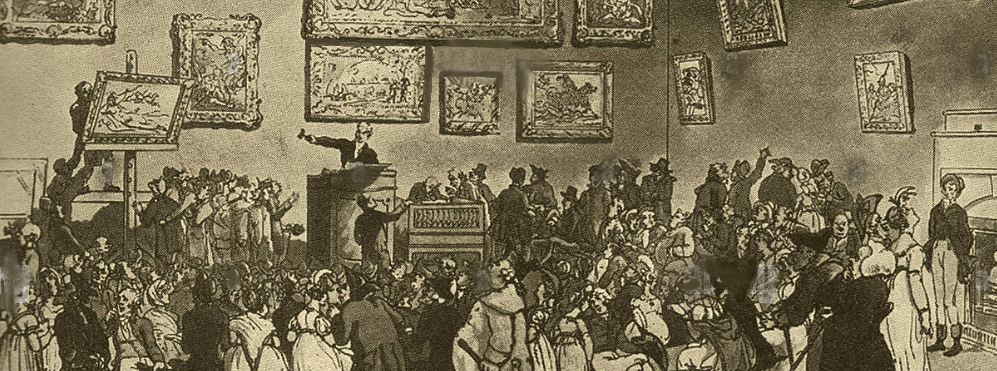
So, we’ve got the houses, the auction houses, small and big, though to call one a small house will probably have one tossed out the door. Houses epitomize the fake it and make it crap. Their stories are presented as true fact, more so than any other selling arena, and are elaborate, filled with drama and occasion, pomp and ceremony, and men tapping tables with silly, little gavels as if with each sale, the truth has prevailed. This perpetuating of a myth of value is another MAJOR failure in the industry,
Its only art, folks. Its good shit, but it ain’t all that important!
How dealers play
So, a quick and not unusual story of a “dealer,” a gallery artist-representative. My mother was in her final days of fighting a losing battle with cancer and had decided to surrender to it, refusing any more treatment. The family had come together with her for a last goodbye. An artist, she had her work displayed in a nearby gallery, and so I thought to go look at her work, see what they had of her’s hanging on those walls. I went with my wife, and while we were looking at my mother’s paintings on that wall, her wall, and a “sales” person approached us. Some very basic conversation ensued, and within just three minutes, this “person” whispers quietly to us, “You know, the artist is dying.”
I looked at the guy with a pause, one including a subtly dirty look I’m sure, one meant to cause discomfort, and finally said, ‘“yes, I know. She’s my mother.” This boyscout-dork quietly, and awkwardly just faded away into nothingness. He knew he wouldn’t be needed beyond that. No sale, Chucky.
It was strange to witness that everything I’d ever heard could actually happen, but it’s true.
Artmongers prefer that their customers (or “clients”) don’t understand the industry, or even the art itself. That way they, these art professionals, can just wing it, and since they don’t understand it themselves, they can just make shit up as they go along, and tell anything they want to anyone, as if they are the ultimate authority, though one who actually has no real authority at all.
Where we came from
Today, its just a few decades beyond a hundred years since the first art gallery of the modern age opened up in Paris, France. This happened during a very cool, wild and tumultuous, culturally-expanding time in France during the Belle Epoch, a time when a small group of artists, outsiders, artists attempted successfully to shake off the shackles of the elitist Paris Salon academicians (officials/jurists of the national academy) and church officials, cardinals, bishops and such, both groups of which were the ultimate tyrants when it came to approving what a painting should be, and what it should never be.
The response to this control came from a ragtag group of non-academic artists who were refused entry into the “prestigious” Salon and its shows. This band of artists became the David that brought down the dreaded Goliath — they had, somehow, a serious punk-rock rebel, freedom-fighter, insurgent, way about them. They’d paint together, and more importantly drink and eat together, which went hand in hand with countless twice-daily meetings where this group would discuss how they could get their work to be shown. To the Paris Salon, these individuals were just plain terrorists that could not be tolerated, or conceded to, and there was a lot of moaning and groaning. In the end, in just a one month period, the Salon lost their exclusivity in being the only voice to represent artists, the only venue that limited what they showed.
Enter the Impressionists
Around one hundred fifty years ago, cameras were shaking up the world of art and the photograph became the new method for portraying things realistically. The result of printing a photo set a new level for reproduction of what was real. Prior to that, realism in art was confined to the recent Rococo and Romantic ethos for imagery. In paintings, people certainly did look like people, trees looked like trees, or pretty darned close. When the camera came along, some artists would question their reason for existence, why even exist, they would ask. People wouldn’t need painters for portraits anymore. Technology does that. A few artists, though, well, they pivoted. They realized they could do something different in displaying the normal, the real, the acceptable, the status-quo, and they could do it any way they wanted, not in the way that was dictated to them by Church and State.
These were the Impressionists. They wanted to show their work, but had no venue with the status-quo of the powers that were. A photographer acquaintance opened his own space, an existing studio and photo gallery, to these painters to have a show, one scheduled to be at the same time as the Salon exhibition. Just the idea had people mortified, at this. There was criticism even before the show opened. But, the show did open, and it ran its course, with great effect!
In real time, however, just as the show opened, the Impressionists were labeled as such quickly by a Salon-supporting journalist. This man attended the show with the sole purpose of publishing his critique of this which wasn’t art. He enjoyed his fringe-status as one of the insiders, one of the club, one of the boys. By calling this group the Impressionists, he made it clear that the name was given in derogatory disdain. Just another case of a non-artist defining an artist’s reality.
The implications of this story astound, and will be cleared up in Part Two of this madness.
Where the Modern Art Industry is today

Today, we’re in a place where analysis is more important when buying art than just looking at something and saying “Wow, that’s cool!” The charlatans want art as commodity – that’s where its value lies. Consider the extreme proliferation of either Jean-Michel Basquiat clones and kopy-kats, or superhero/cartoon character popart. This is work that sells at volume. This is failure.
Art is a good place for these shysters because art is subjective, and we’re to think it’s immune to standard modes of valuation and they can price it as they wish – to prove in court a seller’s price-gouging is near impossible. The questions that dealers asks themselves are – “Can this be sold? How can I sell this? Can it be packaged?” Art is nothing until this happens. It is not good enough to stand on its own without professional marketing that has no need for truth and integrity. Failure, failure, failure.
So that’s how it is today, our art “industry” has been built on the rubble of an elitist/gate-keeping structure fallen over a century ago with only a change to its facade. The spirit of censorship was good as dead with the Salon from our hallmark rebellion, but the gate-keeping continued. Our marketplace has rebuilt nothing, and has only planted itself on this uneven, unstable terrain left by the old-world . Galleries founded on that Paris Salon-model that failed are built on nothing secure, and today, that gallery arena (galleries of all sizes) are suffering for it. Anything that has been added to this old ethos is just as fragile and conscripted for failure. Meanwhile, the painting moves on, and the movers-and-shakers are at a loss with what to do with their situation , but, the gate-keeping continues. This exclusivity, this pretense, is the major, and final failure of the system of Modern Art. They say “art isn’t for everyone,” and they mean to keep it that way.
Painters paint, just as they always have. Those who watch this painting happening, those who are drawn to it, i.e. the critics, the merchants, the lingerers and malingerers, well, they need to know things, irrelevancies that the artists care nothing for. Artist’s have allowed this to happen by desiring and seeking representation, but what else is there to do? Artists just want to paint with their artists’ eyes and artists’ hands, and since artists tend to see things differently, somebody who doesn’t know what those things are that the artist sees needs to have someone else who doesn’t know what those things are explain those things to them. The ignorant leading the ignorant into buttloads of dipshittery and everything gets lost in this translation.
So yeah, artists need representation, it seems self-evident. The machine is in place, so up steps the non-artistic, art-professional, one who hopefully, or most-likely, is at least an art-lover with some ideals. Not being artists, you’d think they’d be in a better position to explain this strange thing called art to other non-artists — it’d be a birds-of-a-feather kind of party, but, that’s where we end up in a mystical, mythological land where the blind lead the blind, Talking story designed to manifest a money-making agendas, the same agenda that was originally in the hands of the church and Salon, telling us which art is valid and which isn’t.
These commercially packaged works are such a small amount of the art in this world, but that’s something you shouldn’t know. You need to think that that’s all there is, anything else is irrelevant. If its affordable, its irrelevant. If you can’t see it in their galleries, its irrelevant. Its in our ignorance where we need to be kept. We have to buy their story, just as we need to believe it, and we need to believe that’s its the story we have, but it isn’t.
Today, that archaic and corrupt Salon is alive-and-well, channeled into various road shows claiming status as the greatest art-fair of the season. Its a real carnival of large empty convention spaces converted into week-long, short-lived, pop-up galleries billed by the square meter or foot, with prices up to a couple hundred thousand bucks just for the week. Visit one of the more prestigious art-fairs, and you’ll see slick-and-polished superficiality and leaving, you’ll be certain you’ve seen the cutting edge of art. Visit many of these temporary galleries, and be prepared to see the red-dot SOLD on all the works, or be turned away with the words, “we have nothing for you Madam. This work is all reserved? Convenient, really, for an elitist ethos, and also revealing that sales are not the motivation of paying to display at these mini-salons.
I’m sure that you want NOTHING to do with such bullshit, who would other than cigar-smoking, caviar-eating, stuff-shirted, elite types.
The good news is that things really have changed with the turn of the last century, and particularly with the Covid-era.
Enter the indie-artist
Art is rarely seen in its original form, in any era. That’s how bereft our culture is when it comes to art – seeing it, understanding it, enjoying it. We only see the tip of the iceberg. Its only in today’s online world that any artist can have their work seen, and knowing photos are always a poor substitute to the real thing – its a big step up from that prior exclusivity. That being said, because of those online opportunities, more art is being shown, and more art is being seen, than ever before in the complete history of art.
While functional online galleries were in place before COVID came along, that system wasn’t nearly as popular, necessary, or developed as it is today. The unrepresented, the disenfranchised, have stepped up in the form of the Indie-artist. With this, there is more art available from around the world to around that same world itself than even before through reputable online galleries. There is no place that is without art. Buying through online markets can carry return guarantees, free shipping depending, and other benefits, while you are actually buying direct from the artist and having access to contact them.
Indy-artists are artists that cut through the fogs of our industry middlemen through self-marketing, self-promotion, and self-representation. They are solely responsible for their image and their branding. Artists are realizing that being creative can, indeed, come in handy once they’re dealing with the business aspects of being an artist. If an Indy artist comes with a rep, a package, a brand, it is one that comes from the artist, not with the artist.
So, while one market, the traditional market, is suffering, the other, the online market is wide open and prospering, and people have a new freedom from the complexities of trying to find art that’s accessible. Its the Indy-artist that brings honesty and integrity into the world of Modern Art. Thankfully, more people, more art lovers and collectors are more savvy today, and more sophisticated than ever, and the Modern Art market is NOT prepared for that. The Modern Art Industry IS NOT prepared to sell art to just anyone, but if you love art, and you want it to enrich your life, to be an expression of your taste, something that will improve your home surroundings, something that can tell your guests who you are, this new market is exploding, and can and will take care of you.
Be sure to read this one regarding our new age of the Indy-artist from Steven Light, aka Slart.
Why Buying Art will make you Richer
(and it has nothing to do with money)
NOTE: None of this overview or critique is directed at our honest players in the game of art. Integrity, as rare as it is, does exist out there in the selling arena, though instead of being the norm in the industry, it’s only nicely refreshing,. Thankfully, our millennial age has done much for the refusal of the commercial.
Up soon – the meat of the Modern Art Industry, where I discuss genres, movements, eras, periods, and other what-have-yous.


Leave a Reply