
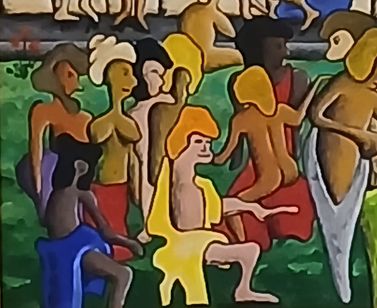
Figure groups is not a term I’ve ever seen used in fine arts, I didn’t learn it in school, but its a term I use whenever I paint large groups of people. Its tradition shows itself used prominently in much of Renaissance art, with that tradition carrying on through virtually every art period since in the Western Art tradition, and most particularly in my favored periods, the Mannerist, Baroque, Rococo and Romantic periods, not to ignore the utterly fascinating though short-lived Northern Rennaisance era.

The detail from this painting shows a group of eight figures, with seven of those figures surrounding a single, central figure ( I call him Smooth Bob, because he’s smooth, stylish, sauve, even). Bob is the one in the foreground with only one arm and one leg in a bright yellow robe. I also borrow the figure to the right (who we can call Legless Harry if you like) from another, smaller group, to complete Smooth Bob’s frame. Whether Bob is important here or not won’t be covered here, but the participatory nature of both art and figure groups might have you, the viewer, decide why Bob, or Harry, are important, but I’d have to add that our heroes in life are never more important than that story’s supporting cast, because without that support, that cast, our hero’s would always end up as crusty old gimps who never did a thing. There’s power in numbers.
In this painting, there are over 60 figures mostly in groups like this, plus some individuals that are assigned to no groups whatsoever. Figure groups can blend and figure groups can define. Raphael’s “School of Athens” from the High-Renaissance period serves as great example of compositional use of defined groups, vague groups, and singular figures all combined on one highly populated canvas. As a rhetorical question, how many groups can you see below?

All this to say that figure groups are quite the convenient tool when used in a compositional function. I’m able to treat a figure group as a single element, versus it being many elements. I have my space for any singular element of design, and drawing out this space, I’ve found that with any number of what-have-yous, be them apples, people, or Campbell soup cans, doing six or eight of these what-have-yous is really no more difficult or time consuming than doing one.
That’s what I’ve got for you today, but I’d like to leave you with this one quote from Oscar Wilde –
”God and other artists are always a little obscure.”


Leave a Reply