


In the beginning they said, “Let there be art!” And there was art. They saw the art – they saw that it was good. They separated the form from the color. They called the form – Drawing! And the color they called – Painting! It was wet, and then it was dry – in one day.
The gods created them – painting and drawing they created them. And they saw everything they had made and said, “This is good.” The two are everywhere – it’s the way of the 10,000 things. There is little in our world that exists without painting or drawing, and it is never that you’ll find something completely and solely one or the other, for one is always within the other, somewhere, and the other is always in the one.

That’s how it is – painting within drawing and and drawing within painting – all is expressed in form and color. The two work together in a forever dance of interchangeability, sometimes one more dominant than the other to the point that the other seems to be non-existent, but that other is there, it’s only hiding in the rotational qualities of what we call our reality and its spinning earth – things are always exposed in their desire to be mated. Line, the essence of drawing, wishes to expose itself somewhere in all fields of color, while color dreams to exist within all form, in all drawing. Its folly to think that we can avoid things such as these.
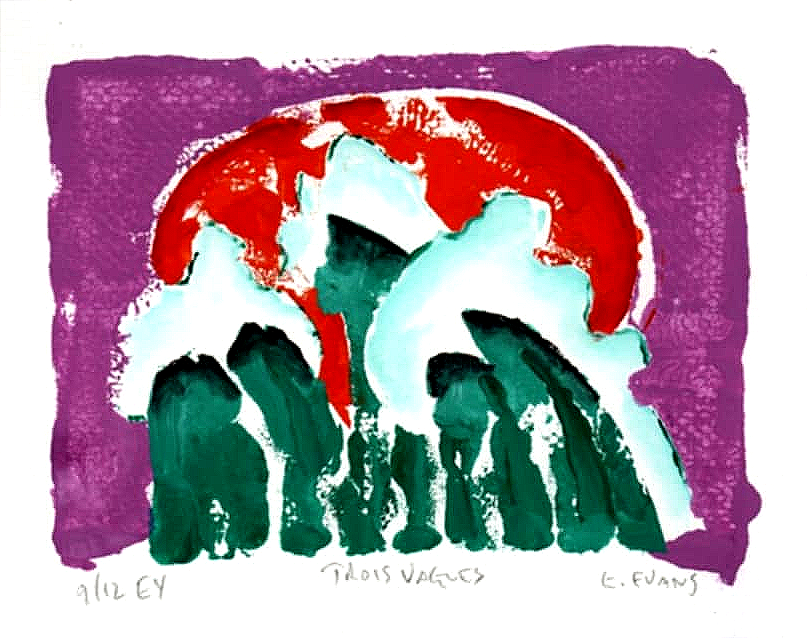
Form and color become drawing and painting -if I were to define these two terms simply and broadly, I would say that both drawing and painting would be the activity of applying an image of sorts via some medium to a support of some kind, with the painting activity including the application of color to that support. Sometimes drawing precedes painting, sometimes it arises with the painting, and sometimes its seen only afterwards. Sometimes, painting arises first and the drawing is only a result of that activity, and not a goal.
So, let’s see if I can do this one…. Bear in mind, any failure on my part to explain subtleties does not null the following facts, it will only show my ineptitude with defining the near undefinable, with naming the near unnameable. Form always contains and color, with the exception of black, always reflects – drawing line contains light while painting color reflects it. Within both drawing and painting can be highlight and shadow, but only in the use of color applied to some form or other comes the conflict, tension and dance of temperature – with color comes the warms and comes the cools to some degree of shared co-existence. Using color to display within highlight is an evident thing, though detrimental to color. More importantly, using color within shadow lets an artist benefit from the greater reflective predisposition and proclivity of shadow. It’s in that shadow one finds true color revealed. Consider how much better you can see on a bright, sunny day when you’re wearing good sunglasses. Color is born in that muted light – color booms and shines when light is lessened. This is why painters squint their eyes to half-shut – that simple action reduces light and filters out the excess information, the visual static and noise. A black object is black because it absorbs all light – it reflects no color. A white object reflects light – it reflects all color. White is complete presence of light, black is a complete lack of it.
Form is stable, its measurable – it absorbs and pulls, its defined and contained, precise, and while seemingly able to exist without its mate, it attracts color, it wants it because it is able only to mimic it via shadow and light, via tones of a hatched or halftoned, grey world. Color is unstable – it is not rational. Color is easily influenced by light and its companion colors – it’s relative, subjective, moody and and its wily changes depend on infinite circumstance. Color reflects and pushes, it bursts in varying degrees and thrills your senses – color seeks form to be contained, if only for a moment, for once contained it insists on violating those boundaries, on influencing its neighbor, it insists on influencing things outside of any line or confinement. Line does not change in context, color does. Line is permanent and unchanging, color is transient. Within line itself polarity is embodied in degrees of straightness and curve. Within color, these polarities, these qualities, are displayed within highlight and shadow, tone and value, intensity and subtlety. Form and color, drawing and painting, are pulled together as a mated pair, always playing, sometimes one in front of the other, sometimes revealing and sometimes obscuring the other.
As American artist Vincent Disiderio would say, an image appears to hide the void from us – that terrifying reality of pure emptiness, of pure non-existence. The blank, white canvas is that void, and artists rush in (where angels fear to tread, maybe) to cover that canvas-white void as quickly as they can if only to avoid seeing the reality of his or her true existence – the reflection of their true selves. Ironically, its in the need to hide the truth that the truth of ourselves is revealed.

Pablo Picasso once said that art is a lie through which truth is revealed. In the early 1900’s, he and George Braques collaborated on works and images that were no less than deconstructive of all things representational. These developments were driving them closer and closer towards pure abstraction, however, that “pure abstraction” they sought is highly elusive, if not completely unattainable, and Picasso quickly recognized this. Some years later, he would reveal that “I have a horror of so-called abstract painting.…When one sticks colors next to each other and traces lines in space that don’t correspond to anything, the result is decoration.” Continuing, he said “There is no abstract art. You must always start with something. Afterwards you can remove all trace of reality. There’s no danger then…because the idea of the object left an indelible mark.” Of course, Some might say that Pablo by this point, having long stopped his pursuit of analytic cubism, was threatened by the pushing of limits that other artists had taken to this impossible dream, this “non-representatonal” lack of form.

Consider America’s Abstract Expressionist Jackson Pollack who once said that “Every good artist paints what he is.” Pollack painted himself as a warrior, a soldier going into battle. He spent the better part of his life fighting that battle that would never be won – that of creating pure, non-representational, abstract art. His paintings would elude him as much as they did many, for each drip and splatter that he laid down was in itself already a sort of form – it was color contained by definition, a drippy, wiggled line that happened to be the same color as its subject, the drip. In attempting to create something that had no reference, Pollock was forever haunted by his work, knowing that his drips were actually representational of drips, and hence not truly abstract. Each drip, at its most minimum, was a painted image of a drip of paint, each drip he made represented that drip he so carefully crafted. At times, even when finished, out of his work would appear drawing, drawings necessarily unintended if one was an abstract painter, but those drawings were there nonetheless. With Pollock, form would expose itself out of the chaos of wild and erratic mark-making. With this, we can say there is no purely abstract art, which means all things in our world must have some sort of form, and thus have some kind of representational quality, and that you will find some line, some drawing, revealing itself to some degree in all painting, even if that work dubbed as abstract.

Its ironic that in trying to hide that reality of truth that artists paint to hide themselves, in so doing they reveal themselves. In each and every painting, be them figurative, abstract, still lives, landscapes and so on, all artists cover an emptiness from which all things are emitted with images of themselves, images that contain, reveal and reflect themselves, images that are generated and spewed forth from that terrifying and brilliant void that is god’s womb. Again, each time we paint a portrait, a tree, a savage beast, it is the painter who becomes the subject. Be it the face of a child, a vase and an orange, a bowl of guacamole and dishes shattered on the floor, it is the artist we see represented by these things. When Van Gogh paints sunflowers, it is Van Gogh we see – when Monet paints haystacks, its Monet we are looking at. Don’t be fooled, we are all painting self-portraits. All these things we paint are ourselves and nothing else – we are those things we paint, and in that, the truth is revealed.
I suppose my point is this – with all the distinctions we can make between drawing and painting as creative activities, they are nonetheless one and the same thing, two sides of the same coin. One is not greater that the other, though embracing the two can be a filling of your artistic practice, for nothing is exclusive. This doesn’t mean that you can’t work from one extreme to the other, exploring the definition of black-ink line art with no shading one day, and then next attempting to grasp the ungraspable abstract in full and living color. Then, having defined a changing playing field, you can run like a child, adventuring in all the degrees between color and form, painting and drawing, abstract and representation.
Or, you can ignore the offerings of both and choose just one, but rest assured, if you only paint, drawing will come through, somewhere, and if you think you only draw, the magic of color is eluding you.


Leave a Reply to Painting Persuasive Phrases and the Role of Rhetoric in the Visual Arts – The Art of Gregory EvansCancel reply